How Florida Humidity Effects Indoor Home Temperature

Corey Creekmore • March 19, 2026

Man playing guitar-shaped thermometer, sweating, with musical notes.

Share this article

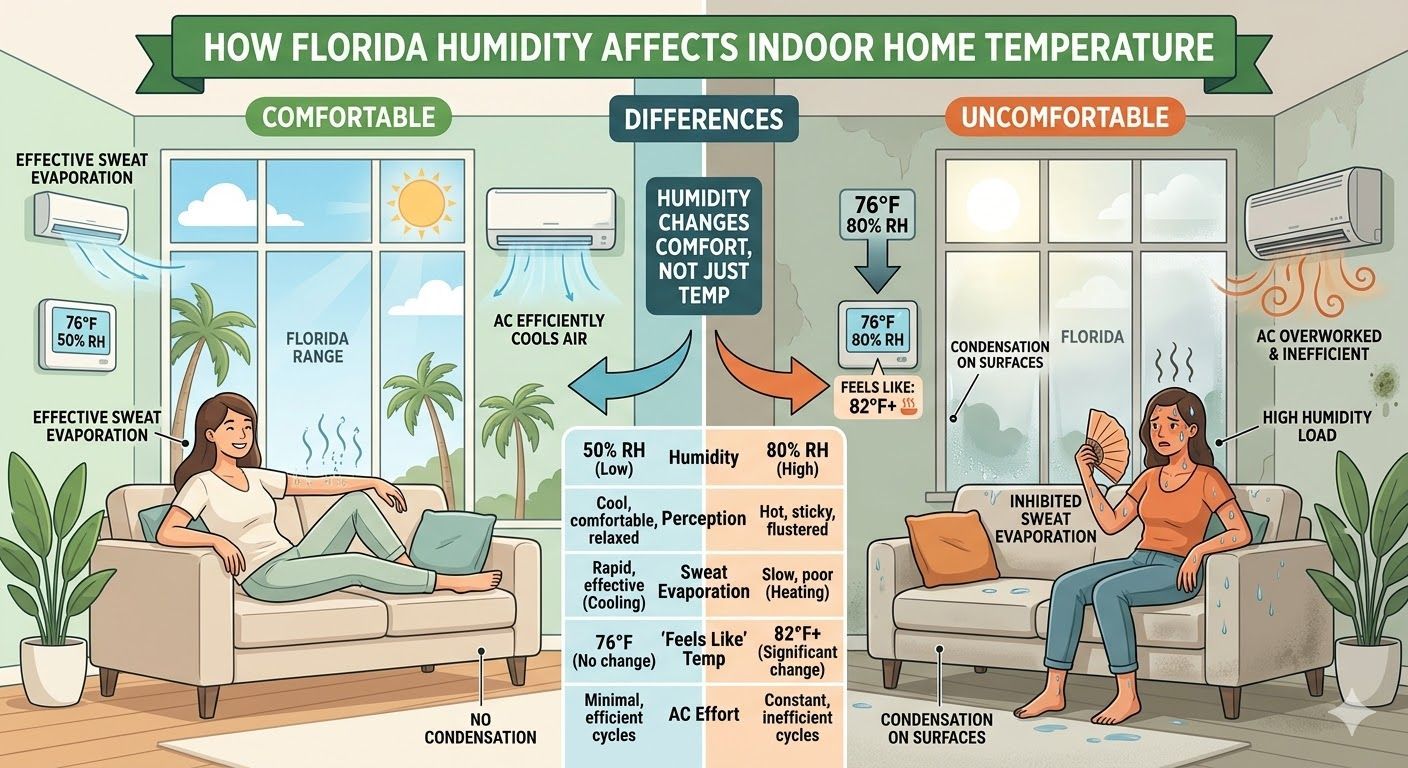
An infographic diagram illustrating how Florida humidity affects indoor comfort, comparing two side-by-side home environments at the same temperature (76°F) but different humidity levels. The left

The Sticky Truth: How Florida Humidity Affects Your Indoor Home Temperature

Living in the Sunshine State is a dream for many, but Florida's climate presents a unique set of challenges, particularly when it comes to maintaining indoor comfort. While the warm temperatures are a draw, it's the high humidity that often truly tests both our physical tolerance and our air conditioning systems. Understanding how this pervasive moisture impacts your indoor home temperature and overall comfort is essential for managing your environment effectively and efficiently. This article explores the intricate relationship between Florida's humidity and your home's thermal comfort, going beyond just the numbers on the thermometer to explain why "it’s not just the heat, it's the humidity."


Understanding the Basics: Temperature vs. Humidity

Before diving into how Florida humidity specifically affects indoor temperature, it's crucial to understand the two key players: air temperature and relative humidity.


Air Temperature: This is a measure of the kinetic energy of the air molecules, which we perceive as heat or cold. It's the number displayed prominently on your thermostat.


Relative Humidity (RH): This is the amount of moisture (water vapor) currently in the air, expressed as a percentage of the maximum amount of moisture the air can hold at that specific temperature. The warmer the air, the more moisture it can hold. So, 90% humidity on a 95°F day feels significantly more oppressive than 90% humidity on a 70°F day.


The fundamental reason humidity impacts our comfort is because of how the human body regulates its own temperature. We primary cool ourselves through sweat evaporation. When sweat evaporates from our skin, it takes heat with it, cooling our bodies down.

+1

  • In low humidity, the air is dry and can easily absorb the moisture from our sweat, allowing for efficient evaporation and cooling.
  • In high humidity, the air is already saturated with moisture. Sweat has a harder time evaporating into the air, making it more difficult for our bodies to shed excess heat. We feel hotter and sticker, even if the air temperature isn't excessively high.


This perception is quantified by the heat index, which combines air temperature and relative humidity to determine what the temperature actually feels like to the human body. High humidity can make an 88°F day feel like a sweltering 100°F or more.


The Infiltration: How Humidity Enters Your Home

Florida’s humidity doesn’t stop at your front door. It seeks every opportunity to seep inside your air-conditioned living space, battling against your attempts to keep it dry and cool. This infiltration happens through several primary pathways:

  1. Air Leaks: No home is completely airtight. Humid outdoor air finds its way in through tiny cracks and gaps around windows and doors, gaps in your foundation, and penetrations for plumbing or electrical lines. This process, known as air infiltration, introduces both heat and moisture, which is harder for your AC to manage.
  2. Ventilation: Introducing fresh outdoor air is important for indoor air quality, but it also brings in Florida's signature humidity. Natural ventilation (opening windows) or mechanical ventilation systems (like whole-house fans or ERVs/HRVs) that aren’t properly managed can easily overload your AC with moisture. Even simple exhaust fans in bathrooms and kitchens, while necessary to remove indoor humidity, pull humid outdoor air in through gaps in the home’s envelope.
  3. Ductwork Leaks: Leaky or poorly sealed ductwork can pull humid air into your ventilation system from unconditioned spaces like attics or crawlspaces before it even reaches your living areas. This not only increases the humidity load but also forces your AC to cool and dehumidify this hot, moist air before it distributes it, significantly decreasing efficiency.
  4. Diffusion: To a lesser extent, moisture can actually diffuse through building materials like drywall and concrete, especially if there are significant moisture differences between inside and outside.


The AC Battle: Heat vs. Moisture (Sensible vs. Latent Heat)

Your air conditioning system has a two-fold mission, and understanding this duality is key to grasping how humidity affects indoor temperature. It must manage two types of heat:

  • Sensible Heat: This is the heat you can "sense" or measure with a thermometer. Removing sensible heat lowers the actual air temperature in your home.
  • Latent Heat: This is the heat associated with the phase change of water (from vapor to liquid). Removing latent heat means removing the moisture (humidity) from the air.


In a dry climate, your AC can focus primarily on removing sensible heat to lower the temperature quickly and efficiently. However, in Florida, your AC is fighting a war on two fronts. A significant portion of its energy—sometimes up to 50% or more on particularly humid days—is dedicated to removing the latent heat (moisture) before it can even begin to substantially lower the sensible heat (temperature).


Here's the mechanism: Warm, humid indoor air is drawn over the cold evaporator coils in your AC unit. As the air cools below its dew point temperature (the temperature at which air becomes saturated with moisture and condensation occurs), the water vapor in the air condenses onto the cold coils, essentially "raining" out of the air. This condensed water drips into a condensate pan and is drained away. The now cooler, drier air is then distributed throughout your home.


How High Humidity Indirectly Impacts Indoor Temperature

While the number on the thermostat represents sensible heat, high humidity indirectly impacts the perception of indoor temperature in several significant ways, forcing you to adjust your thermostat differently than you might in a drier climate.


1. The "Feels Like" Temperature Factor

Because high humidity impedes the body's natural cooling process (sweat evaporation), you will feel hotter at a given temperature than you would in a lower-humidity environment.


  • In a home with 40% relative humidity, 75°F might feel perfectly comfortable.
  • In a home with 75% relative humidity, that same 75°F will feel muggy, sticky, and significantly warmer—more like 78°F or 80°F to the human body.


This discrepancy between the actual temperature and the "feels like" temperature is the primary way humidity affects how you manage your indoor environment. You are likely to set your thermostat lower to achieve a similar level of perceived comfort, which leads to higher energy consumption and more wear and tear on your AC unit.


2. Increased Cooling Load

As mentioned, your AC must remove substantial amounts of moisture (latent heat) before it can effectively lower the air temperature (sensible heat). This means that on highly humid days:

  • Longer AC Run Times: Your air conditioner needs to run for much longer cycles to process the excessive moisture in the air. A well-sized AC unit should run long enough to achieve good dehumidification (at least 15-20 minutes). However, extreme humidity can force it to run nearly constantly, especially during the peak of the day.
  • Reduced Cooling Capacity: A significant portion of your AC’s rated cooling capacity is "used up" just removing moisture, leaving less capacity available for actual temperature reduction. This makes it feel like your AC isn't cooling as effectively, even if it's working properly.
  • Decreased Efficiency: While AC systems are designed to dehumidify, doing so takes a substantial amount of energy. Constantly battling high moisture levels significantly reduces the overall energy efficiency of the system, leading to higher electricity bills compared to operating in a drier environment with the same outdoor temperature.


3. The Short-Cycling Conundrum

Ironically, having an air conditioner that is too large (oversized) for your home can make humidity problems worse. An oversized AC unit will cool your home to the set temperature very quickly and then shut off. However, these short cooling cycles are often not long enough to adequately cool the evaporator coils below the dew point to remove significant amounts of moisture.


This creates an environment where the temperature might be low (e.g., 72°F), but the humidity remains high (e.g., 70% or more). You get a cold, clammy feeling that is far from comfortable, often leading homeowners to set the thermostat even lower in a futile attempt to feel better, exacerbating the short-cycling and high energy use.


4. Promoting Heat Retention

Humid air has a higher specific heat capacity than dry air, meaning it holds onto heat more effectively. This makes it more difficult for your AC to cool the volume of air in your home because the air itself is resisting the temperature change more stubbornly than dry air would. Furthermore, materials in your home (carpet, furniture, drywall) will absorb and hold onto moisture, potentially making them feel slightly warmer or just less comfortable to the touch.


Recognizing the Signs of High Indoor Humidity

Knowing when your indoor humidity is too high is crucial. Ideal indoor relative humidity is generally considered to be between 40% and 60%. While your AC should manage this, several factors can cause it to spike. Watch for these signs:


  • The "Clammy" Feeling: Your skin feels sticky, and sheets or furniture might feel damp or cool-damp.
  • Visible Condensation: Water droplets forming on the inside of windows, cold water pipes, or even on walls.
  • Musty Odors: A tell-tale sign of mold or mildew growth, which thrives in high humidity.
  • Peeling Wallpaper or Blistering Paint: Excess moisture weakens adhesives and finishes.
  • Warping Wood: High humidity can cause wood flooring, cabinetry, and furniture to swell and warp.
  • Health Issues: Increased allergy or asthma symptoms, or respiratory irritation, often linked to mold spores or dust mites that flourish in humid conditions.


Solutions: Effectively Managing Humidity and Temperature in Florida

Given how aggressively Florida's humidity fights your AC, simply setting the thermostat low isn't always the most effective or efficient strategy. A multi-pronged approach is necessary.


1. Utilize a Dehumidifier

In Florida, your AC is your primary dehumidifier. However, supplementary dehumidifiers can make a significant difference, especially during shoulder seasons (when it’s humid but not hot enough for the AC to run much) or to assist an AC unit during peak humidity:


  • Portable Dehumidifiers: These are excellent for spot-treating specific problem areas like laundry rooms, bathrooms, or bedrooms. They are relatively inexpensive and can remove several gallons of water per day.


  • Whole-Home Dehumidifiers: This is the most effective solution. Installed directly into your HVAC system, a whole-home dehumidifier works in conjunction with your AC, specifically targeting moisture removal throughout the entire house. It can keep your home consistently at a comfortable 45-50% humidity, allowing you to raise your thermostat temperature by several degrees while maintaining (or even improving) your level of comfort, ultimately saving energy.


2. Optimize AC Settings and Maintenance

Your AC is your front line of defense. Ensure it's in top working order to maximize its dehumidification potential:

  • Ensure Proper Sizing: Verify that your AC unit is correctly sized (in BTUs/tons) for your home's square footage, insulation, and window placement. If you suspect your unit is oversized (cools quickly but leaves the air clammy), consult an HVAC professional about options like installing a variable-speed air handler or replacing the unit.
  • Use the "Auto" Fan Setting: Never run your thermostat fan on "ON" during the cooling season in a high-humidity climate. The "ON" setting causes the fan to run constantly. After a cooling cycle finishes, the evaporator coil is still wet with condensed water. Running the fan then blows that moisture right back into your living space before it has a chance to drain away, re-humidifying your home. The "Auto" setting ensures the fan only runs when the compressor is cooling, allowing for effective moisture removal.
  • Consider a Smart or Dehumidifying Thermostat: Modern thermostats can offer advanced features:
  • Dehumidification Settings: Some thermostats (often paired with variable-speed AC units) can "overcool" the home by a degree or two beyond the setpoint specifically to prioritize moisture removal.
  • Variable-Speed Blowers: Thermostats controlling variable-speed air handlers can signal the blower to run at a lower speed. Moving air more slowly over the cold coils increases the time for condensation, improving dehumidification efficiency.
  • Perform Regular Maintenance:
  • Clean/Replace Air Filters: A dirty filter restricts airflow, which can cause the evaporator coil to become too cold and potentially freeze over, completely halting all cooling and dehumidification. It also forces the system to work harder, reducing efficiency.
  • Check Condensate Drains: Ensure the drain line is clear. A clogged line will back up, potentially causing water damage, triggering a safety shutoff switch, and preventing any moisture removal.
  • Professional Tune-Ups: Schedule annual professional maintenance. Techs can check refrigerant levels (low levels drastically reduce dehumidification), clean the coils (improving heat transfer), and ensure all components are operating at peak efficiency.


3. Strategic Mechanical Ventilation

Managing how and when you ventilate is crucial:

  • Use Exhaust Fans Consistently: Run bathroom exhaust fans during and for at least 20-30 minutes after showers and baths to remove steam directly at the source. Run kitchen exhaust fans when cooking, especially when boiling water or producing significant steam. Ensure these fans vent directly outdoors, not into your attic, which would just move the problem elsewhere.
  • Manage Outdoor Ventilation: While fresh air is good, avoid extensive natural ventilation (opening multiple windows for long periods) during peak heat and humidity days, as this just overwhelms your AC. If you use a mechanical ventilation system like an ERV or HRV, ensure it’s properly designed to exchange both heat and moisture and is operating correctly.


4. Fortify Your Home's Envelope

Preventing humid air from leaking in is just as important as removing it once it’s inside:

  • Seal Air Leaks: Caulk gaps around windows, doors, and where plumbing or electrical wires enter the home. Use weatherstripping to ensure a tight seal on doors and windows that open. Check the integrity of the vapor barrier in your crawlspace or attic if applicable.
  • Seal Ductwork: Have a professional test and seal your ductwork, especially in unconditioned areas like attics. Leaky ducts are a major contributor to high indoor humidity and significant energy waste.


The Financial and Comfort Payoff

Understanding the relationship between Florida humidity and indoor temperature is more than just a matter of curiosity; it has a real impact on your comfort and your wallet. By managing humidity proactively:

  1. Enhanced Comfort: You can eliminate that persistent clammy, sticky feeling. A dry environment at 76°F feels significantly more comfortable than a humid one at 72°F.
  2. Lower Energy Bills: By managing humidity effectively (especially with solutions like a whole-home dehumidifier), you can comfortably raise your thermostat setting by 2 to 4 degrees. For every degree you raise your thermostat, you can save roughly 1-3% on your cooling costs. The reduction in AC run time also significantly lowers energy usage.
  3. Extended AC Lifespan: An AC unit that isn't constantly battling excessive humidity doesn't have to run as hard or as often. This reduces wear and tear on major components like the compressor and fan motor, potentially extending the system's overall lifespan and preventing costly premature replacements.
  4. Healthier Indoor Environment: Maintaining humidity below 60% significantly inhibits the growth of mold, mildew, and dust mites, which are major triggers for allergies and respiratory issues. This leads to a healthier, safer living space for you and your family.


Conclusion

In Florida, your indoor temperature and humidity are intrinsically linked. Ignoring the impact of humidity is a recipe for high energy bills, a clammy, uncomfortable home, and an overworked AC system. By understanding that "it's the humidity" that's often the true cause of discomfort, and by implementing strategic solutions to actively manage moisture levels—including proper AC maintenance, utilizing dehumidification, sealing air leaks, and using a modern thermostat correctly—you can win the battle against Florida's muggy climate and create a consistently cool, dry, and comfortable sanctuary inside your home.

Recent Posts

By Corey Creekmore April 1, 2026
Searching for reliable AC repair in Fort Myers, Florida? B&B Cool Air offers expert HVAC installation and maintenance to keep your home cool and comfortable.
By Corey Creekmore March 27, 2026
Stay cool in Cape Coral! Learn how to maintain your AC, combat salt air corrosion, and save on energy bills with our expert guide for Southwest Florida homes.
By B & B Cool Air March 20, 2026
Heat pump services in Marco Island, FL from B & B Cool Air deliver year-round comfort for coastal homes. Learn what makes these systems ideal for your property.
By Corey Creekmore March 14, 2026
1. Strategic Placement: The First Line of Defense If you are installing a new unit or moving an existing one in North Fort Myers or Saint James City , placement is your first tactical decision. Windward vs. Leeward: Whenever possible, place the unit on the side of the home that faces away from the prevailing winds. In Southwest Florida, the strongest salt-spray usually comes from the West and South. By placing the unit on the East or North side of a structure in Naples or Cape Coral , the house itself acts as a giant windbreak, filtering out the heaviest salt particles before they reach the delicate coils. Physical Barriers: Utilizing solid fencing (not lattice) or dense, salt-tolerant landscaping can create a "buffer zone." Hedges around units in Iona or Cypress Lake can catch a significant portion of airborne salt, provided the plants are kept at least three feet away to allow for proper airflow. 2. The "Freshwater Rinse" Ritual The most effective DIY maintenance for a coastal HVAC system is also the simplest: the garden hose. Salt only causes corrosion when it remains on the metal surface. Homeowners living within five miles of the coast—especially in Sanibel , Captiva , and Pine Island —should rinse their outdoor condenser units once every two weeks. If you live further inland, such as Gateway or Alva , once a month is usually sufficient. The Right Technique: Turn the thermostat to "Off" to ensure the fan isn't spinning. Use a gentle stream from a garden hose (never a pressure washer, which will flatten the fins). Spray the coils from the top down, allowing the water to carry the salt out through the bottom of the unit. Focus specifically on the corners where salt and sand tend to accumulate. 3. Specialized Coastal Coatings In the HVAC industry, we often talk about "Coastal Units" or "Seacoast Packages." These are systems where the coils have been dipped in a specialized epoxy or polyurethane coating (often referred to as Phenolic coating) during the manufacturing process. If you already have a standard unit in Port Charlotte or Labelle , you can have aftermarket coatings applied. These thin, clear films provide a barrier that prevents the salt-laden moisture from ever making physical contact with the aluminum and copper. While this adds a slight cost upfront, the ROI is massive when you consider it can prevent a $6,000 replacement just a few years down the line. 4. Addressing the "Sacrificial Anode" Much like the tech used on boat motors in the Matlacha pass, some high-end HVAC systems can be fitted with sacrificial anodes. These are pieces of zinc or magnesium that are bolted to the unit's frame. Because these metals are "more active" than copper or aluminum, the salt air will attack the anode first, leaving your expensive coils untouched. Once the anode has dissolved, you simply replace it with a new one. 5. The Role of Enclosures and Shields In high-intensity spray areas like Vanderbilt Beach or Boca Grande , some residents use "hail shields" or specialized louvers. While these are designed to protect against debris, they also serve to break the velocity of the wind. By slowing down the air before it hits the coils, the heavier salt crystals drop out of the air stream. However, a word of caution for residents in Fort Myers and Lehigh Acres : never "wrap" your unit in plastic or tight covers during the summer. This traps moisture and heat, creating a "sauna effect" that will accelerate corrosion and fry the electrical components faster than the salt ever could. 6. Electrical Protection: Don't Forget the Brains While the coils get all the attention, salt air is also a conductor of electricity. In the humid environments of Babcock Ranch or Punta Gorda , salt can build up on the contactors and circuit boards inside the outdoor unit. This leads to "tracking" or short-circuiting. During your regular seasonal checks, ensure that the electrical cabinet is tightly sealed. Using a dielectric grease on terminal connections can help repel moisture and salt, ensuring that a $200 circuit board doesn't fail because of a microscopic layer of Gulf salt. 7. Professional Chemical Cleaning While the freshwater rinse is great for homeowners in Estero and Bonita Springs , it doesn't remove the salt that has already begun to bond with the metal. Once a year, a professional deep-clean using "alkaline" or "acid-free" coil cleaners is necessary. These chemicals are specifically designed to neutralize the acidity of salt and lift out the deep-seated "white rust" that a garden hose cannot reach. For those in the high-corrosion zones of Cape Coral and Naples , this isn't just a "cleaning"—it's a chemical restoration of the system's integrity. Conclusion: Living in Harmony with the Gulf Living in Southwest Florida means accepting that the environment is "hard" on man-made objects. From the sun beating down on homes in Labelle to the salt mist rolling over Sanibel , our climate demands a higher level of vigilance. By implementing a regular rinsing schedule, choosing coated coils for your next replacement, and being mindful of placement, you can effectively "neutralize" the salt air. You don't have to choose between living near the water and having a reliable AC system. With the right preventative measures, your HVAC system can survive the Florida elements and keep you cool for a decade or more, regardless of how close you are to the beautiful, salty Gulf.
By Corey Creekmore March 6, 2026
Struggling with your AC every afternoon in Lehigh Acres? You're not alone. Discover why our local architecture and unique humidity are sabotaging your comfort.
By Corey Creekmore February 25, 2026
Florida, known for its sunshine and beautiful beaches, isn't always immune to air quality challenges. While generally good, certain factors can contribute to poor air days, impacting residents' health and well-being. But fear not! There are proactive steps you can take to combat air quality issues and breathe easier in the Sunshine State. Understanding Florida's Air Quality Landscape Florida's air quality can be influenced by several factors: Pollen: With abundant flora, pollen counts can soar, especially during spring and fall, triggering allergies and respiratory issues. Ozone: Ground-level ozone, a harmful air pollutant, can form on hot, sunny days when pollutants from vehicles and industrial sources react. Wildfires: While less frequent than in other states, wildfires can occur, releasing smoke and particulate matter that significantly degrade air quality. Saharan Dust: Occasionally, plumes of Saharan dust can travel across the Atlantic, reaching Florida and contributing to hazy skies and increased particulate matter. Practical Steps to Protect Yourself Here are some actionable tips to mitigate the effects of poor air quality: Stay Informed with Air Quality Alerts: Keep an eye on local air quality forecasts and alerts from organizations like the EPA (Environmental Protection Agency) or your local health department. Websites and apps often provide real-time data on air quality index (AQI) levels. Limit Outdoor Activity on High Pollution Days: When air quality is poor, especially for sensitive groups (children, the elderly, and those with respiratory conditions), it's best to reduce prolonged or strenuous outdoor activities. If you must be outside, consider doing so during off-peak hours when pollution levels might be lower. Improve Indoor Air Quality: Air Purifiers: Invest in a good quality air purifier with a HEPA filter to remove particulate matter, allergens, and other pollutants from your home. Keep Windows Closed: On high pollution days, keep windows and doors shut to prevent outdoor pollutants from entering your home. Regular Cleaning: Dust and vacuum regularly to minimize indoor allergens and dust. Avoid Indoor Pollutants: Limit the use of aerosol sprays, scented candles, and harsh cleaning chemicals, which can contribute to indoor air pollution. Wear a Mask When Necessary: If you're particularly sensitive or need to be outdoors on a day with very poor air quality (e.g., during a wildfire event), consider wearing an N95 mask. These masks are designed to filter out fine particulate matter. Maintain Your Vehicle: Regularly maintaining your car helps ensure it runs efficiently and produces fewer emissions, contributing to cleaner air overall. Support Clean Air Initiatives: Advocate for policies that promote clean energy, reduce industrial emissions, and encourage public transportation. Supporting local environmental groups can also make a difference. Florida's Efforts Towards Cleaner Air Florida actively monitors and manages air quality through various state and local programs. The Department of Environmental Protection (FDEP) continuously tracks air pollutants and implements strategies to reduce emissions, ensuring that the air remains clean for residents and visitors alike. Conclusion While Florida can experience periods of compromised air quality , being informed and taking proactive measures can significantly reduce your exposure and protect your health. By staying vigilant and implementing these tips, you can continue to enjoy the beautiful environment Florida has to offer, breathing easy every step of the way.
By Corey Creekmore February 19, 2026
1. Weak Airflow One of the most immediate signs of a problem is weak or inconsistent airflow coming from your vents. This could be due to a clogged air filter, issues with the blower motor, or even leaky ductwork. Reduced airflow means your heat pump is struggling to distribute conditioned air throughout your home, leading to uneven temperatures and increased energy consumption. 2. Strange Noises Your heat pump should operate relatively quietly. If you start hearing unusual noises like grinding, squealing, rattling, or hissing, it's a clear indicator something is amiss. Grinding noises often point to motor bearing issues, squealing could be a worn belt, and hissing might signify a refrigerant leak. Don't ignore these auditory warnings! 3. Increased Energy Bills Have your energy bills suddenly skyrocketed without a corresponding increase in usage? This is a common sign that your heat pump is working harder than it should to maintain your desired temperature. Inefficiency can stem from various problems, including low refrigerant levels, a dirty coil, or a malfunctioning thermostat. 4. Uneven Heating or Cooling If some rooms in your home are significantly warmer or cooler than others, your heat pump might not be distributing conditioned air effectively. This could be due to issues with zoning, ductwork problems, or even a faulty compressor struggling to produce consistent temperatures. 5. Frequent Cycling Your heat pump should cycle on and off in predictable intervals. If it's turning on and off much more frequently than usual (short-cycling), it could be a sign of an oversized unit, a dirty air filter, or low refrigerant. Short-cycling not only wears down components faster but also reduces efficiency. 6. Icing on the Outdoor Unit While some frost on the outdoor unit during cold weather is normal, a thick layer of ice building up is not. This often indicates a problem with the defrost cycle, low refrigerant, or restricted airflow. Icing can severely hinder your heat pump's ability to extract heat from the outside air, leading to a loss of heating capacity. 7. Puddles or Leaks Around the Indoor Unit Any water pooling around your indoor unit is a cause for concern. This could be due to a clogged condensate drain line, which prevents the water extracted from the air from draining properly. If left unaddressed, this can lead to water damage and mold growth. 8. Blowing Cold Air in Heating Mode (or Warm Air in Cooling Mode) This is perhaps one of the most obvious signs. If you set your heat pump to heat, but it's blowing cold air, or vice versa, something is fundamentally wrong. This could point to a problem with the reversing valve, a refrigerant leak, or a faulty compressor. 9. Foul Odors If you notice strange smells emanating from your vents, such as a burning odor, a musty smell, or even a rotten egg scent, it's important to investigate. A burning smell could indicate an electrical issue, while a musty odor might signal mold growth in your ductwork or evaporator coil. 10. Old Age  While not a direct "sign" of a problem, an aging heat pump (typically over 10-15 years old) is more prone to breakdowns and inefficiencies. Even if it's still running, an older unit might be costing you more in energy bills than a newer, more efficient model. Consider a professional inspection to assess its remaining lifespan and efficiency. Don't Delay, Call a Professional! If you notice any of these 10 signs, it's crucial to contact a qualified HVAC technician promptly. Attempting DIY repairs on a complex heat pump system can be dangerous and often leads to further damage. A professional can accurately diagnose the issue, perform necessary repairs, and help extend the life of your heat pump, ensuring your home remains comfortable and your energy bills stay manageable. Regular maintenance is also key to preventing many of these issues in the first place!
By B & B Cool Air February 18, 2026
Professional ductwork services in Estero, FL improve air quality and system efficiency. Discover expert solutions for cleaner, healthier indoor air.
By B & B Cool Air February 17, 2026
Duct cleaning in Bonita Springs, FL improves indoor air quality and system efficiency by removing dust, debris, and contaminants from your home.
indoor air quality
By Corey Creekmore February 12, 2026
Improve your health and home comfort with our guide on 10 ways to improve indoor air quality. From plants to HVAC tips, breathe easier with these expert steps.
Show More